




Skip Navigation
Skip to contents

Cancer Res Treat : Cancer Research and Treatment

OPEN ACCESS

Articles

Page Path
HOME > Cancer Res Treat > Volume 41(2); 2009 > Article
Original Article Cytoplasmic Expression of HuR is Related to Cyclooxygenase-2 Expression in Colon Cancer
Sung-Jig Lim, M.D.1, Suk-Hwan Lee, M.D.2, Sun Hyung Joo, M.D.2, Jeong Yoon Song, M.D.2, Sung Il Choi, M.D.2
Cancer Research and Treatment : Official Journal of Korean Cancer Association 2009;41(2):87-92.
DOI: https://doi.org/10.4143/crt.2009.41.2.87
Published online: June 30, 2009

1Department of Pathology, East-West Neo Medical Center, KyungHee University College of Medicine, Seoul, Korea.

2Department of Surgery, East-West Neo Medical Center, KyungHee University College of Medicine, Seoul, Korea.

Correspondence: Sung Il Choi, M.D. Department of Surgery, East-West Neo Medical Center, KyungHee University School of Medicine, #149, Sangil-dong, Gangdong-gu, Seoul 134-727, Korea.
Tel: 82-2-440-6136, Fax: 82-2-440-6295, drchoi@khu.ac.kr
• Received: October 2, 2008   • Accepted: November 11, 2008

Copyright © 2009 Korean Cancer Association

  • 10,051 Views
  • 65 Download
  • 43 Crossref
prev next
  • Purpose
    HuR, human family embryonic-lethal abnormal vision-like protein, can bind to mRNA and stabilizes the nucleic acid in the cytoplasm, resulting in more efficient translation. HuR is predominantly present in the nucleus and shuttles between the nucleus and cytoplasm. HuR stabilizes cyclooxygenase-2 (Cox-2) mRNA in several cancers, including breast, stomach, lung and brain cancer.
  • Materials and Methods
    We investigated the expression and cellular location of HuR, as well as evaluated Cox-2 expression in 79 colorectal cancer patients with the use of immunohistochemical methods. The biological implications of HuR localization and Cox-2 expression in colorectal carcinoma were evaluated.
  • Results
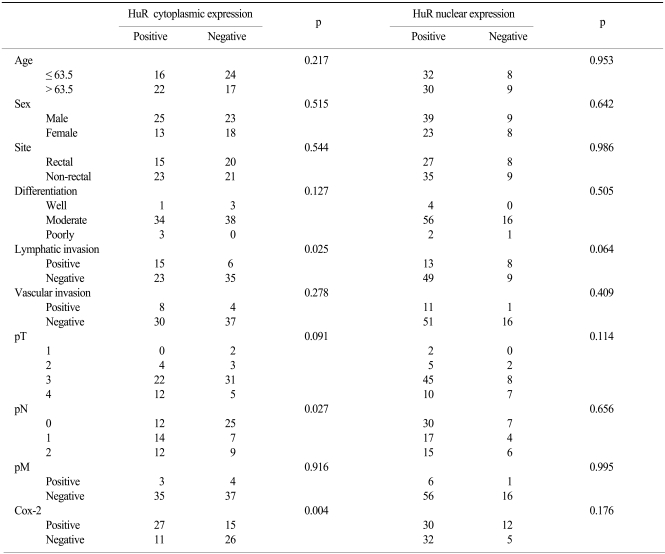
    Nuclear HuR expression was observed in 59 (74.7%) tumors and cytoplasmic HuR expression was seen in 25 (31.6%) tumors. Cox-2 immunoreactivity was noted in 42 (53%) tumors. The expression of cytoplasmic HuR was significantly associated with Cox-2 expression (p=0.004). Cytoplasmic expression of HuR showed a correlation with lymphatic invasion (p=0.025) and the presence of a lymph node metastasis (p=0.027). The presence of nuclear HuR showed no correlation with Cox-2 expression or any other of the clinicopathological parameters that were examined.
  • Conclusion
    These results suggest that cytoplasmic translocation of HuR is associated with Cox-2 expression for some colorectal carcinomas.
The regulation of gene expression in eukaryotes is controlled at both the transcriptional and posttranscriptional level (1). Post-transcriptional gene regulatory events, especially regulation of mRNA turnover, have emerged as fundamental and effective means to alter the expression of functionally related genes (2). The investigation of post-transcriptional regulatory mechanisms centers on the association of a given RNA-binding protein with its target mRNA (3). The proteins make mRNA stable by binding to AU-rich elements (AREs) in the 3'-untranslated region of some mRNAs. Thus, the binding effectively lengthens the presence of a given mRNA and consequently, the amount of protein expressed is increased. Among the ARE-binding proteins identified, the human family embryonic lethal abnormal vision (ELAV)-like proteins that consist of four members (Hel-N1/HuB, HuC, HuD and HuR) have been well characterized (4). HuR is expressed in many cell types, mainly in the cellular nucleus, while the other three proteins are usually expressed in terminally differentiated tissue (4). Several studies have shown that HuR can shuttle between the nucleus and cytoplasm and localization of HuR in the cytoplasm is required for its mRNA stabilizing function (5). HuR binds to labile transcripts containing AREs, such as mRNAs for proto-oncogenes, cytokines and cytokine-response genes in the nucleus. The HuR-mRNA complex is then transported to the cytoplasm (6), where the stabilized mRNA can be translated into protein more efficiently.
Increased expression of cyclooxygense-2 (Cox-2) has been implicated in carcinogenesis. There is evidence that mRNA stability and translational efficiency are major steps for the control of Cox-2 expression, although an increase of Cox-2 gene transcription partly accounts for the increase of Cox-2 protein expression (7,8). There is an ARE in the 3-untranslated region of Cox-2 mRNA that provides the binding site for HuR, resulting in increased mRNA half-life (9). Cox-2 is overexpressed in several malignant tumors and the increase in expression may due to dysregulation of mRNA stability (10-12).
Recently, a correlation between the protein expression level of HuR and Cox-2 was found in colon, breast, stomach, ovary and uterine cervical cancer cells (9,13-16). There have been no reports on the relationship between HuR and Cox-2 expression in colorectal cancer tumors from patients in South Korea.
Colorectal cancer is one of the leading causes of cancer-associated death and the third most common malignant tumor found in patients in Western countries (17). The incidence and the mortality rate of colorectal cancer have also been on the increase in South Korea (18). We investigated the expression and cellular location of HuR and measured Cox-2 expression with the use of immunohistochemical methods. The biological implications of HuR localization and Cox-2 expression in colorectal carcinoma were also evaluated.
We collected 79 cases of primary colorectal cancer patients from May 2006 to December 2007 at the East-West Neo Medical Center. The clinical characteristics of patients were evaluated from hospital records. Resected tissue specimens were fixed in 10% buffered formalin and were embedded in paraffin. Histological sections cut from paraffin blocks were stained with hematoxylin and eosin, and all of the stained slides were reviewed. For effective and fast detection, tissue array slides were made. Two cores of representative cancer tissue (2.0 mm in diameter) were obtained from the original paraffin block and the cores were inserted into a new paraffin block with 40 holes. The tissue microarray block also contained three normal colorectal cores. Serial sectioned slides were produced and hematoxylin and eosin staining was performed.
Immunohistochemical procedures were carried out on 4-µm tissue sections from each tissue microarray block using the Bond Polymer Intense Detection system (Leica Microsystems, North Ryde, NSW Australia) according to the manufacturer's instruction with minor modifications. In brief, 4-µm sections of formalin-fixed and paraffin-embedded tissues were deparaffinized by the use of Bond Dewax Solution (Leica Microsystems), and an antigen retrieval procedure was preformed using Bond ER solution (Leica Microsystems) for 30 minutes at 100℃. Endogenous peroxidase was quenched by incubation with hydrogen peroxide for five minutes. Sections were incubated for 15 minutes at ambient temperature with a monoclonal COX-2 antibody (1 : 400 dilution; Dako, Glostrup, Denmark) and a monoclonal HuR antibody (3A2, 1 : 300 dilution; Zymed, South San Francisco, CA), respectively, using biotin-free polymeric horseradish peroxidase (HRP)-linker antibody conjugate system in a Bond-max automatic slide stainer (Leica Microsystems). As a positive control for Cox-2 expression, we used a human colon carcinoma cell line known to overexpress Cox-2. When more than 10% of the cancer cells showed cytoplasmic staining for Cox-2, the tumor was judged as positive for Cox-2 expression. We observed normal breast glands as a positive control for HuR staining. We evaluated the percentage of positive cells and intensity of staining for the evaluation of the HuR staining status. The percentage of positive cells was scored as follows: 0 (0% positive cells), 1 (< 10% positive cells), 2 (10 to < 50% positive cells), 3 (50 to < 80% positive cells), 4 (> 80% positive cells). The intensity of cytoplasmic and nuclear staining was scored as follows: 0 (negative staining), 1 (weak staining), 2 (moderate staining), 3 (strong staining). For the immunoreactive score, values from 0 to 12 were multiplied by the percentage of the positive cell score and intensity of the staining score. We classified the cases as having negative or weak expression when the immunoreactive score was 0 to 5; a score from 6 to 12 was regarded as strong expression.
All statistical analyses were performed using MedCalc 9.6.0.1 statistical software. The relationships between variables were studied using the chi-squared test. A probability value below 0.05 was considered as statistically significant.
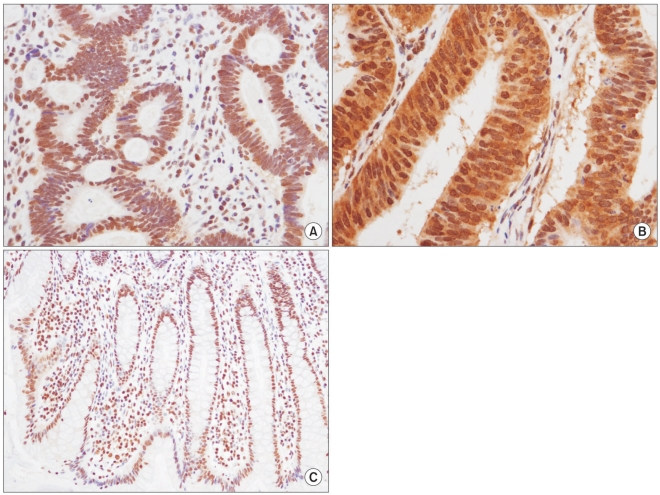
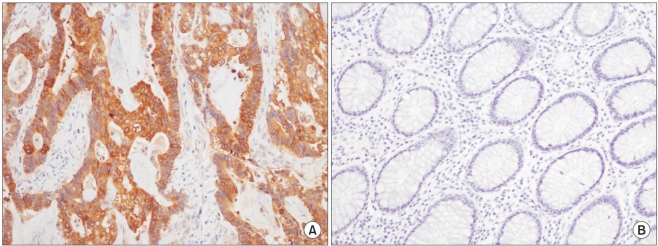
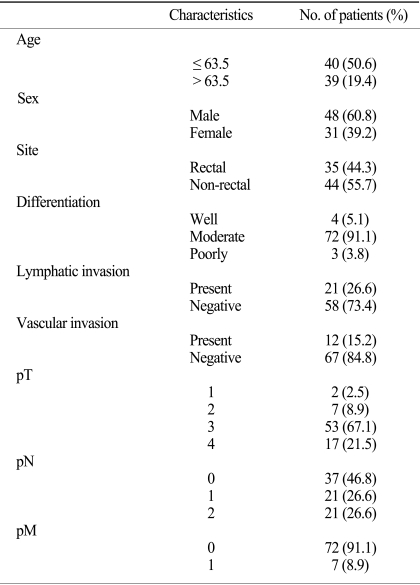
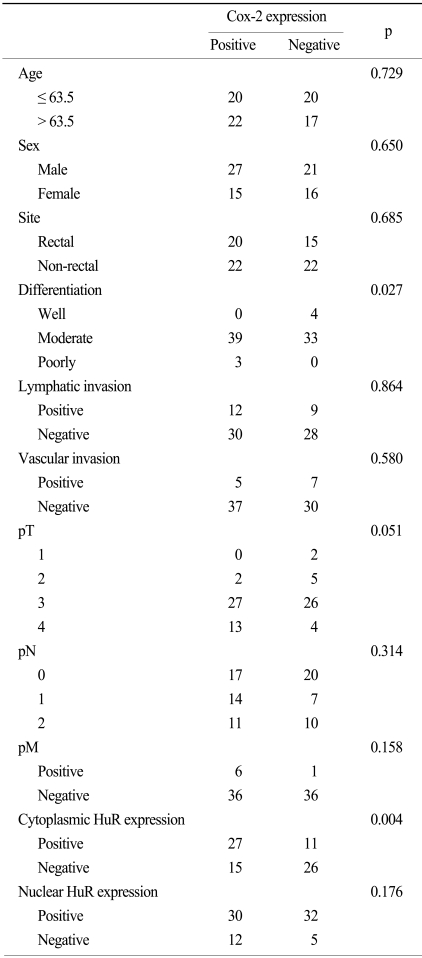
The mean and median age of the patients at the time of the initial diagnosis was 62.4 years (age range, 39~85 years) and 63.5 years, respectively. Of all of the patients, 48 (60.8%) were male. In the study population, 67.1% of patients had moderately differentiated tumors, 5.1% of the patents had well differentiated tumors and 3.8% of the patients had poorly differentiated tumors. Of the 79 patients, 35 patients (44.3%) had a rectal cancer while 44 (55.7%) patients had a non-rectal colon cancer. A lymph node metastasis was present in 42 patients (53.2%). Baseline patient characteristics are shown in Table 1. HuR expression in the nucleus and cytoplasm of cancer cells was present in 59 (74.7%) and 25 (31.6%) cases, respectively (Fig. 1A, B). As shown in Table 2, cytoplasmic expression of HuR significantly correlated with Cox-2 expression (p=0.004) and lymphatic invasion (p=0.027). Other clinicopathological factors such as age, sex, site, differentiation, vascular invasion and TNM stage showed no significant correlation with HuR cytoplasmic expression. For nuclear expression of HuR, we could not observe any association between nuclear expression of HuR and the clinicopathological factors (Table 2). Cox-2 expression was seen in 42 (53%) colorectal cancer cases (Fig. 2). The expression of Cox-2 in the adjacent normal colorectal mucosal epithelium was very weak or negative. Cox-2 expression showed a significant correlation with differentiation (p=0.027). Cox-2 expression increased with a higher T stage, but the finding was not statistically significant (p=0.051). Other clinicopathological factors examined showed no significant correlations (Table 3).
In this study, we demonstrated that colorectal cancer showed predominantly nuclear expression (74.7%) of HuR, and increased cytoplasmic expression of HuR was significantly associated with increased lymph node metastasis (p=0.027) and lymphatic invasion (p=0.025), whereas nuclear expression of HuR showed no association with the examined clinicopathological parameters. Furthermore, we found that cytoplasmic expression of HuR was significantly associated with Cox-2 expression. Our results are in accord with the previous studies that reported that the HuR protein translocates from the nucleus to the cytoplasm during tumorigenesis (13-16). Eleven cases of negative Cox-2 expression showed positive cytoplasmic HuR expression in our study. This finding suggests that the possibility of other additional regulatory mechanisms for Cox-2 expression exist. Even though the regulation of mRNA stability of Cox-2 is thought to be an important regulatory step, other mechanisms such as transcriptional control can also exist. Further large-scale studies are needed for the determination of the mechanism of regulation of Cox-2 expression and stabilization of Cox-2 mRNA in cancer cells.
Although the ability of HuR to shuttle from the nucleus to cytoplasm is important for mRNA stabilization, the exact mechanism is not known. Several mechanisms for controlling the cellular location have been studied. Recent studies have shown that mitogenic-activated protein kinase-2 increased cytoplasmic translocation of HuR and the stability of ARE-containing mRNAs (19). The translocation of HuR to the cytoplasm can be induced by stress caused by agents such as UV light, DNA damaging agents or T cell activation, while AMP-activated kinase can inhibit the translocation of HuR to the cytoplasm (20-22).
There are some other mRNAs, such as the mRNAs for tumor necrosis factor α, cyclin A, cyclin B1, MARCKS, uPA and uPA receptor that are stabilized by HuR (23-25). Based on the known functions of HuR, we believe that HuR might play an important role in cell cycle regulation, apoptosis, angiogenesis, inflammation, and tumor growth. Moreover, HuR can be a potential target for molecular tumor therapy with consideration of these multiple effects.
The cytoplasmic expression of HuR may be a part of a regulatory pathway (s) that controls the expression of Cox-2 in colorectal cancer. Additional studies with a larger number of specimens are required to determine if HuR might be a potential target for tumor therapy.

This work was supported by the KyungHee University Research Fund in 2006 (KHU-20061221).

  • 1. Chen CY, Shyu AB. AU-rich elements: characterization and importance in mRNA degradation. Trends Biochem Sci. 1995;20:465–470. PMID: 8578590ArticlePubMed
  • 2. Fan J, Yang X, Wang W, Wood WH 3rd, Becker KG, Gorospe M. Global analysis of stress-regulated mRNA turnover by using cDNA arrays. Proc Natl Acad Sci USA. 2002;99:10611–10616. PMID: 12149460ArticlePubMedPMC
  • 3. Frederickson RM. Fluidigm. Biochips get indoor plumbing. Chem Biol. 2002;9:1161–1162. PMID: 12445764ArticlePubMed
  • 4. Ma WJ, Cheng S, Campbell C, Wright A, Furneaux H. Cloning and characterization of HuR, a ubiquitously expressed Elav-like protein. J Biol Chem. 1996;271:8144–8151. PMID: 8626503ArticlePubMed
  • 5. Fan XC, Steitz JA. Overexpression of HuR, a nuclear-cytoplasmic shuttling protein, increases the in vivo stability of ARE-containing mRNAs. EMBO J. 1998;17:3448–3460. PMID: 9628880ArticlePubMedPMC
  • 6. Gallouzi IE, Steitz JA. Delineation of mRNA export pathways by the use of cell-permeable peptides. Science. 2001;294:1895–1901. PMID: 11729309ArticlePubMed
  • 7. Dixon DA, Kaplan CD, McIntyre TM, Zimmerman GA, Prescott SM. Post-transcriptional control of cyclooxygenase-2 gene expression. The role of the 3'-untranslated region. J Biol Chem. 2000;275:11750–11757. PMID: 10766797ArticlePubMed
  • 8. Ristimäki A, Narko K, Hla T. Down-regulation of cytokine-induced cyclo-oxygenase-2 transcript isoforms by dexamethasone: evidence for post-transcriptional regulation. Biochem J. 1996;318:325–331. PMID: 8761489ArticlePubMedPMC
  • 9. Dixon DA, Tolley ND, King PH, Nabors LB, McIntyre TM, Zimmerman GA, et al. Altered expression of the mRNA stability factor HuR promotes cyclooxygenase-2 expression in colon cancer cells. J Clin Invest. 2001;108:1657–1665. PMID: 11733561ArticlePubMedPMC
  • 10. Tatsuguchi A, Matsui K, Shinji Y, Gudis K, Tsukui T, Kishida T, et al. Cyclooxygenase-2 expression correlates with angiogenesis and apoptosis in gastric cancer tissue. Hum Pathol. 2004;35:488–495. PMID: 15116331ArticlePubMed
  • 11. Tsujii M, Kawano S, DuBois RN. Cyclooxygenase-2 expression in human colon cancer cells increases metastatic potential. Proc Natl Acad Sci USA. 1997;94:3336–3340. PMID: 9096394ArticlePubMedPMC
  • 12. Sutton KM, Wright M, Fondren G, Towle CA, Mankin HJ. Cyclooxygenase-2 expression in chondrosarcoma. Oncology. 2004;66:275–280. PMID: 15218294ArticlePubMed
  • 13. Do SI, Do IG, Kim GY, Lee S, Kim YW, Park YK, et al. Correlation between cyclooxygenase-2 expression and HuR cytoplasmic translocation of breast cancer. Korean J Pathol. 2008;42:75–80.
  • 14. Mrena J, Wiksten JP, Thiel A, Kokkola A, Pohjola L, Lundin J, et al. Cyclooxygenase-2 is an independent prognostic factor in gastric cancer and its expression is regulated by the messenger RNA stability factor HuR. Clin Cancer Res. 2005;11:7362–7368. PMID: 16243808ArticlePubMed
  • 15. Denkert C, Weichert W, Pest S, Koch I, Licht D, Köbel M, et al. Overexpression of the embryonic-lethal abnormal vision-like protein HuR in ovarian carcinoma is a prognostic factor and is associated with increased cyclooxygenase 2 expression. Cancer Res. 2004;64:189–195. PMID: 14729623ArticlePubMed
  • 16. Lim SJ, Kim HJ, Kim JY, Park K, Lee CM. Expression of HuR is associated with increased cyclooxygenase-2 expression in uterine cervical carcinoma. Int J Gynecol Pathol. 2007;26:229–234. PMID: 17581403ArticlePubMed
  • 17. Jemal A, Murray T, Ward E, Samuels A, Tiwari RC, Ghafoor A, et al. Cancer statistics, 2005. CA Cancer J Clin. 2005;55:10–30. PMID: 15661684ArticlePubMed
  • 18. Death by cause. Korea National Statistical Office. Korean Stational Information Service (KOSIS); www.nso.go.kr
  • 19. Subbaramaiah K, Marmo TP, Dixon DA, Dannenberg AJ. Regulation of cyclooxgenase-2 mRNA stability by taxanes: evidence for involvement of p38, MAPKAPK-2, and HuR. J Biol Chem. 2003;278:37637–37647. PMID: 12826679ArticlePubMed
  • 20. Wang W, Furneaux H, Cheng H, Caldwell MC, Hutter D, Liu Y, et al. HuR regulates p21 mRNA stabilization by UV light. Mol Cell Biol. 2000;20:760–769. PMID: 10629032ArticlePubMedPMC
  • 21. Atasoy U, Watson J, Patel D, Keene JD. ELAV protein HuA (HuR) can redistribute between nucleus and cytoplasm and is upregulated during serum stimulation and T cell activation. J Cell Sci. 1998;111:3145–3156. PMID: 9763509ArticlePubMedPDF
  • 22. Wang W, Fan J, Yang X, Füer-Galban S, Lopez de Silanes I, von Kobbe C, et al. AMP-activated kinase regulates cytoplasmic HuR. Mol Cell Biol. 2002;22:3425–3436. PMID: 11971974ArticlePubMedPMC
  • 23. Wang W, Caldwell MC, Lin S, Furneaux H, Gorospe M. HuR regulates cyclin A and cyclin B1 mRNA stability during cell proliferation. EMBO J. 2000;19:2340–2350. PMID: 10811625ArticlePubMedPMC
  • 24. Wein G, Rössler M, Klug R, Herget T. The 3'-UTR of the mRNA coding for the major protein kinase C substrate MARCKS contains a novel CU-rich element interacting with the mRNA stabilizing factors HuD and HuR. Eur J Biochem. 2003;270:350–365. PMID: 12605686ArticlePubMed
  • 25. Tran H, Maurer F, Nagamine Y. Stabilization of urokinase and urokinase receptor mRNAs by HuR is linked to its cytoplasmic accumulation induced by activated mitogen-activated protein kinase-activated protein kinase 2. Mol Cell Biol. 2003;23:7177–7188. PMID: 14517288ArticlePubMedPMC
Fig. 1
Strong nuclear (A,×400) and cytoplasmic expression (B,×400) of HuR were noted in a colorectal cancer specimen, but the normal colonic mucosa showed diffuse nuclear staining in the crypt glands (C,×200).
crt-41-87-g001.jpg
Fig. 2
Diffuse strong cytoplasmic expression of Cox-2 for an adenocarcinoma in the colon (A,×200) was seen, and no staining was seen in the normal mucosa (B,×200).
crt-41-87-g002.jpg
Table 1
Characteristics of patients
crt-41-87-i001.jpg
Table 2
Cytoplasmic and nuclear expression of HuR and association with clinicopathological factors
crt-41-87-i002.jpg
Table 3
Cox-2 expression and association with clinicopathological factors
crt-41-87-i003.jpg

Figure & Data

REFERENCES

    Citations

    Citations to this article as recorded by  
    • HuR/miR-124-3p/VDR complex bridges lipid metabolism and tumor development in colorectal cancer
      Fengxing Huang, Luping Bu, Mengting Li, Youwei Wang, Runan Zhang, Yu Shao, Kun Lin, Hong Yang, Qiu Zhao, Lan Liu
      Carcinogenesis.2025;[Epub]     CrossRef
    • Structural, biological, and biomedical implications of mRNA interactions with the master regulator HuR
      Madeline E Clark, Andrew Farinha, Alan R Morrison, George P Lisi
      NAR Molecular Medicine.2025;[Epub]     CrossRef
    • Targeting the HuR/E2F7 axis synergizes with bortezomib against multiple myeloma
      Ming-yuan Jia, Chao Wu, Ze Fu, Wen-bin Xu, Jia Liu, Cheng-yu Wu, Xin-yi Zeng, Ying-li Wu, Hua Yan
      Acta Pharmacologica Sinica.2025; 46(8): 2296.     CrossRef
    • Deciphering the role of ELAVL1: Insights from pan-cancer multiomics analyses with emphasis on nasopharyngeal carcinoma
      Jindong Xie, Yi Xie, Wencheng Tan, Yimeng Ye, Xueqi Ou, Xiong Zou, Zhiqing He, Jiarong Wu, Xinpei Deng, Hailin Tang, Longjun He, Kailai Li, Peng Luo, Kunhao Bai, Guoxian Huang, Jianjun Li
      Journal of Translational Internal Medicine.2025; 13(2): 138.     CrossRef
    • HuR-Targeted Small-Molecule Inhibitors─Beneficial Impact in Cancer Therapy
      Iwona Rzeszutek, Agnieszka Nowak-Król
      Journal of Medicinal Chemistry.2025;[Epub]     CrossRef
    • Human antigen R: Exploring its inflammatory response impact and significance in cardiometabolic disorders
      Shahenda Salah Abdelsam, Sarah Khalaf Ghanem, Muhammad Ammar Zahid, Hanan H. Abunada, Loulia Bader, Hicham Raïq, Abbas Khan, Aijaz Parray, Laiche Djouhri, Abdelali Agouni
      Journal of Cellular Physiology.2024;[Epub]     CrossRef
    • Targeting the RNA-Binding Protein HuR in Cancer
      Jennifer M. Finan, Thomas L. Sutton, Dan A. Dixon, Jonathan R. Brody
      Cancer Research.2023; 83(21): 3507.     CrossRef
    • CCAAT/enhancer binding protein (C/EBP) delta promotes the expression of PTX3 and macrophage phagocytosis during A. fumigatus infection
      Lulu Liu, Jinjin Zhong, Bilin Chen, Weiping Wang, Haiyan Xi, Xin Su
      Journal of Leukocyte Biology.2022; 111(6): 1225.     CrossRef
    • CRC-derived exosomes containing the RNA binding protein HuR promote lung cell proliferation by stabilizing c-Myc mRNA
      Hui Xiao, Xiong Ye, Vikalp Vishwakarma, Ranjan Preet, Dan A. Dixon
      Cancer Biology & Therapy.2022; 23(1): 139.     CrossRef
    • The RNA-binding protein HuR in human cancer: A friend or foe?
      Xiaoqing Wu, Liang Xu
      Advanced Drug Delivery Reviews.2022; 184: 114179.     CrossRef
    • The Role of RNA-Binding Protein HuR in Lung Cancer by RNA Sequencing Analysis
      Xiong Ye, Qiang Fu, Hui Xiao
      Frontiers in Genetics.2022;[Epub]     CrossRef
    • miR-29b-3p suppresses the malignant biological behaviors of AML cells via inhibiting NF-κB and JAK/STAT signaling pathways by targeting HuR
      Yong-Jing Tang, Wei Wu, Qiao-Qian Chen, Shu-Han Liu, Zhi-Yuan Zheng, Zhao-Lei Cui, Jian-Ping Xu, Yan Xue, Dong-Hong Lin
      BMC Cancer.2022;[Epub]     CrossRef
    • Mechanistic insights into HuR inhibitor MS-444 arresting embryonic development revealed by low-input RNA-seq and STORM
      Yongqiang Nie, Wei Xu, Geng G. Tian, Xiaowei Li, Yan Guo, Xuefeng Liu, Lin He, Zhifeng Shao, Xiaoyong Li, Ji Wu
      Cell Biology and Toxicology.2022; 38(6): 1175.     CrossRef
    • Circular RNA circE2F2 promotes malignant progression of ovarian cancer cells by upregulating the expression of E2F2 protein via binding to HuR protein
      Meiyin Zhang, Ye Xu, Yongjian Zhang, Bing Li, Ge Lou
      Cellular Signalling.2021; 84: 110014.     CrossRef
    • Understanding and targeting the disease‐related RNA binding protein human antigen R (HuR)
      Christopher W. Schultz, Ranjan Preet, Teena Dhir, Dan A. Dixon, Jonathan R. Brody
      WIREs RNA.2020;[Epub]     CrossRef
    • The Role of VEGFA, COX2, HUR and CUGBP2 in Predicting the Response to Neoadjuvant Therapy in Rectal Cancer Patients
      Henrikas Pauzas, Ugne Gyvyte, Tadas Latkauskas, Laura Kairevice, Paulius Lizdenis, Saulius Svagzdys, Erika Birgiolaite, Irma Kuliaviene, Juozas Kupcinskas, Algimantas Tamelis
      Medicina.2020; 56(4): 192.     CrossRef
    • AU-rich element-binding proteins in colorectal cancer
      Noémie Legrand, Dan A Dixon, Cyril Sobolewski
      World Journal of Gastrointestinal Oncology.2019; 11(2): 71.     CrossRef
    • Inhibition of Caspase-2 Translation by the mRNA Binding Protein HuR: A Novel Path of Therapy Resistance in Colon Carcinoma Cells?
      Wolfgang Eberhardt, Usman Nasrullah, Kristina Haeussler
      Cells.2019; 8(8): 797.     CrossRef
    • Lessons from studying the AU-rich elements in chronic inflammation and autoimmunity
      Niki Lourou, Maxim Gavriilidis, Dimitris L. Kontoyiannis
      Journal of Autoimmunity.2019; 104: 102334.     CrossRef
    • High cytoplasmic HuR expression is associated with advanced pT stage, high grade and increased microvessel density in urothelial bladder carcinoma
      Łukasz Piotr Fus, Paweł Pihowicz, Łukasz Koperski, Janina Maja Marczewska, Barbara Górnicka
      Annals of Diagnostic Pathology.2018; 33: 40.     CrossRef
    • Divergent Innate and Epithelial Functions of the RNA-Binding Protein HuR in Intestinal Inflammation
      Eleni Christodoulou-Vafeiadou, Fotis Ioakeimidis, Margarita Andreadou, Giorgos Giagkas, George Stamatakis, Martin Reczko, Martina Samiotaki, Anastasios D. Papanastasiou, Ioannis Karakasiliotis, Dimitris L. Kontoyiannis
      Frontiers in Immunology.2018;[Epub]     CrossRef
    • Green Tea Polyphenol Induces Changes in Cancer-Related Factors in an Animal Model of Bladder Cancer
      Tomohiro Matsuo, Yasuyoshi Miyata, Akihiro Asai, Yuji Sagara, Bungo Furusato, Junya Fukuoka, Hideki Sakai, Chih-Pin Chuu
      PLOS ONE.2017; 12(1): e0171091.     CrossRef
    • Human antigen R as a predictive marker for response to gemcitabine-based chemotherapy in advanced cisplatin-resistant urothelial cancer
      Yasuyoshi Miyata, Kensuke Mitsunari, Asai Akihiro, Shin-Ichi Watanabe, Tomohiro Matsuo, Kojiro Ohba, Hideki Sakai
      Oncology Letters.2017; 13(2): 811.     CrossRef
    • Impact of HuR inhibition by the small molecule MS-444 on colorectal cancer cell tumorigenesis
      Fernando F. Blanco, Ranjan Preet, Andrea Aguado, Vikalp Vishwakarma, Laura E. Stevens, Alok Vyas, Subhash Padhye, Liang Xu, Scott J. Weir, Shrikant Anant, Nicole Meisner-Kober, Jonathan R. Brody, Dan A. Dixon
      Oncotarget.2016; 7(45): 74043.     CrossRef
    • Novel Targets in Pancreatic Cancer Research
      Geoffrey Kozak, Fernando F. Blanco, Jonathan R. Brody
      Seminars in Oncology.2015; 42(1): 177.     CrossRef
    • HuR represses Wnt/β-catenin-mediated transcriptional activity by promoting cytoplasmic localization of β-catenin
      Inae Kim, Jung Hur, Sunjoo Jeong
      Biochemical and Biophysical Research Communications.2015; 457(1): 65.     CrossRef
    • Exome sequencing of a colorectal cancer family reveals shared mutation pattern and predisposition circuitry along tumor pathways
      Suleiman H. Suleiman, Mahmoud E. Koko, Wafaa H. Nasir, Ommnyiah Elfateh, Ubai K. Elgizouli, Mohammed O. E. Abdallah, Khalid O. Alfarouk, Ayman Hussain, Shima Faisal, Fathelrahamn M. A. Ibrahim, Maurizio Romano, Ali Sultan, Lawrence Banks, Melanie Newport,
      Frontiers in Genetics.2015;[Epub]     CrossRef
    • Combinatorial Control of mRNA Fates by RNA-Binding Proteins and Non-Coding RNAs
      Valentina Iadevaia, André Gerber
      Biomolecules.2015; 5(4): 2207.     CrossRef
    • Association ofCELF2polymorphism and the prognosis of nasopharyngeal carcinoma in southern Chinese population
      Yun-Miao Guo, Ming-Xia Sun, Jing Li, Tong-Tong Liu, Hang-Zhen Huang, Jie-Rong Chen, Wen-Sheng Liu, Qi-Sheng Feng, Li-Zhen Chen, Jin-Xin Bei, Yi-Xin Zeng
      Oncotarget.2015; 6(29): 27176.     CrossRef
    • Clinical significance of HuR expression in human malignancy
      Ioly Kotta-Loizou, Constantinos Giaginis, Stamatios Theocharis
      Medical Oncology.2014;[Epub]     CrossRef
    • Expression of the ELAV-like protein HuR in the cytoplasm is associated with endometrial carcinoma progression
      Dandan Wang, Min Wang, Chang’e Hu, Ting Shuang, Yingying Zhou, Xiaoyu Yan
      Tumor Biology.2014; 35(12): 11939.     CrossRef
    • HuR Regulates Alternative Splicing of the TRA2β Gene in Human Colon Cancer Cells under Oxidative Stress
      Yoko Akaike, Kiyoshi Masuda, Yuki Kuwano, Kensei Nishida, Keisuke Kajita, Ken Kurokawa, Yuzuru Satake, Katsutoshi Shoda, Issei Imoto, Kazuhito Rokutan
      Molecular and Cellular Biology.2014; 34(15): 2857.     CrossRef
    • Multiple Functions of the RNA-Binding Protein HuR in Cancer Progression, Treatment Responses and Prognosis
      Jun Wang, Yan Guo, Huili Chu, Yaping Guan, Jingwang Bi, Baocheng Wang
      International Journal of Molecular Sciences.2013; 14(5): 10015.     CrossRef
    • Cytoplasmic HuR expression correlates with P-gp, HER-2 positivity, and poor outcome in breast cancer
      Zhongpeng Zhu, Baocheng Wang, Jingwang Bi, Cong Zhang, Yan Guo, Huili Chu, Xiuju Liang, Chen Zhong, Jun Wang
      Tumor Biology.2013; 34(4): 2299.     CrossRef
    • The flip-flop HuR: part of the problem or the solution in fighting cancer?
      Jacqueline C. Shultz, Charles E. Chalfant
      Journal of Clinical Investigation.2012; 122(1): 16.     CrossRef
    • Myeloid cell expression of the RNA-binding protein HuR protects mice from pathologic inflammation and colorectal carcinogenesis
      Anthie Yiakouvaki, Marios Dimitriou, Ioannis Karakasiliotis, Christina Eftychi, Stamatis Theocharis, Dimitris L. Kontoyiannis
      Journal of Clinical Investigation.2012; 122(1): 48.     CrossRef
    • RNA-binding protein HuR autoregulates its expression by promoting alternative polyadenylation site usage
      Weijun Dai, Gen Zhang, Eugene V. Makeyev
      Nucleic Acids Research.2012; 40(2): 787.     CrossRef
    • HuR's role in gemcitabine efficacy: an exception or opportunity?
      Jonathan R. Brody, Gregory E. Gonye
      WIREs RNA.2011; 2(3): 435.     CrossRef
    • High-constitutive HuR phosphorylation at Ser 318 by PKCδ propagates tumor relevant functions in colon carcinoma cells
      Anke Doller, Christine Winkler, Irina Azrilian, Sebastian Schulz, Sylvia Hartmann, Josef Pfeilschifter, Wolfgang Eberhardt
      Carcinogenesis.2011; 32(5): 676.     CrossRef
    • Cytoplasmic HuR expression correlates with angiogenesis, lymphangiogenesis, and poor outcome in lung cancer
      Jun Wang, Baocheng Wang, Jingwang Bi, Cong Zhang
      Medical Oncology.2011; 28(S1): 577.     CrossRef
    • Association between expression of embryonic lethal abnormal vision‐like protein HuR and cyclooxygenase‐2 in oral squamous cell carcinoma
      Jeong‐Dan Cha, ShengJin Li, In‐Ho Cha
      Head & Neck.2011; 33(5): 627.     CrossRef
    • Posttranscriptional regulation of cancer traits by HuR
      Kotb Abdelmohsen, Myriam Gorospe
      WIREs RNA.2010; 1(2): 214.     CrossRef
    • BRCA1-IRIS overexpression abrogates UV-induced p38MAPK/p53 and promotes proliferation of damaged cells
      K Chock, J M S Allison, W M ElShamy
      Oncogene.2010; 29(38): 5274.     CrossRef

    • PubReader PubReader
    • ePub LinkePub Link
    • Cite
      CITE
      export Copy Download
      Close
      Download Citation
      Download a citation file in RIS format that can be imported by all major citation management software, including EndNote, ProCite, RefWorks, and Reference Manager.

      Format:
      • RIS — For EndNote, ProCite, RefWorks, and most other reference management software
      • BibTeX — For JabRef, BibDesk, and other BibTeX-specific software
      Include:
      • Citation for the content below
      Cytoplasmic Expression of HuR is Related to Cyclooxygenase-2 Expression in Colon Cancer
      Cancer Res Treat. 2009;41(2):87-92.   Published online June 30, 2009
      Close
    • XML DownloadXML Download
    Cytoplasmic Expression of HuR is Related to Cyclooxygenase-2 Expression in Colon Cancer
    Image Image
    Fig. 1 Strong nuclear (A,×400) and cytoplasmic expression (B,×400) of HuR were noted in a colorectal cancer specimen, but the normal colonic mucosa showed diffuse nuclear staining in the crypt glands (C,×200).
    Fig. 2 Diffuse strong cytoplasmic expression of Cox-2 for an adenocarcinoma in the colon (A,×200) was seen, and no staining was seen in the normal mucosa (B,×200).
    Cytoplasmic Expression of HuR is Related to Cyclooxygenase-2 Expression in Colon Cancer

    Characteristics of patients

    Cytoplasmic and nuclear expression of HuR and association with clinicopathological factors

    Cox-2 expression and association with clinicopathological factors

    Table 1 Characteristics of patients

    Table 2 Cytoplasmic and nuclear expression of HuR and association with clinicopathological factors

    Table 3 Cox-2 expression and association with clinicopathological factors


    Cancer Res Treat : Cancer Research and Treatment
    Close layer
    TOP