
 KCA

Articles
- Page Path
- HOME > Cancer Res Treat > Volume 43(2); 2011 > Article
- Review Article The Role of Stereotactic Ablative Radiotherapy for Early-Stage and Oligometastatic Non-small Cell Lung Cancer: Evidence for Changing Paradigms
- Max Dahele, MBChB, MSc, FRCP, FRCR, Suresh Senan, MBBS, PhD, MRCP, FRCR
-
Cancer Research and Treatment : Official Journal of Korean Cancer Association 2011;43(2):75-82.
DOI: https://doi.org/10.4143/crt.2011.43.2.75
Published online: June 30, 2011
Department of Radiation Oncology, VU University Medical Center, Amsterdam, Netherlands.
-
Correspondence: Suresh Senan, MBBS, PhD, MRCP, FRCR. Department of Radiation Oncology, VU University Medical Center, De Boelelaan 1117, Postbox 7057, 1007 MB Amsterdam, Netherlands.
Tel: 31-20-444-0436, Fax: 31-20-444-0410, s.senan@vumc.nl
• Received: May 10, 2011 • Accepted: May 19, 2011
Copyright © 2011 by the Korean Cancer Association
This is an Open-Access article distributed under the terms of the Creative Commons Attribution Non-Commercial License (http://creativecommons.org/licenses/by-nc/3.0/) which permits unrestricted non-commercial use, distribution, and reproduction in any medium, provided the original work is properly cited.


Abstract
- A compelling body of non-randomized evidence has established stereotactic ablative lung radiotherapy (SABR) as a standard of care for medically inoperable patients with peripheral early-stage non-small cell lung cancer (NSCLC). This convenient outpatient therapy, which is typically delivered in 3-8 fractions, is also well tolerated by elderly and frail patients, makes efficient use of resources and is feasible using standard commercial equipment. The introduction of lung SABR into large populations has led to an increased utilization of radiotherapy, a reduction in the proportion of untreated patients and an increase in overall survival. In selected patients, the same ablative technology can now achieve durable local control of NSCLC metastases in a variety of common locations including the adrenal glands, bone, brain, and liver. At the same time as this, advances in prognostic molecular markers and targeted systemic therapies mean that there is now a subgroup of patients with stage IV NSCLC and a median survival of around 2 years. This creates opportunities for new trials that incorporate SABR and patient-specific systemic strategies. This selective mini-review focuses on the emerging role of SABR in patients with early-stage and oligometastatic NSCLC.
Stage I Non-small Cell Lung Cancer
Oligometastases from Non-small Cell Lung Cancer
-
The Department of Radiation Oncology VU University Medical Center has a research agreement with Varian Medical Systems and BrainLAB AG.
NOTES
- 1. Loo BW, Chang JY, Dawson LA, Kavanagh BD, Koong AC, Senan S, et al. Stereotactic ablative radiotherapy: whats in a name? Pract Radiat Oncol. 2011;1:38–39. ArticlePubMed
- 2. Palma D, Senan S. Stereotactic radiation therapy: changing treatment paradigms for stage I nonsmall cell lung cancer. Curr Opin Oncol. 2011;23:133–139. PMID: 21107257ArticlePubMed
- 3. Hurkmans CW, Cuijpers JP, Lagerwaard FJ, Widder J, van der Heide UA, Schuring D, et al. Recommendations for implementing stereotactic radiotherapy in peripheral stage IA non-small cell lung cancer: report from the Quality Assurance Working Party of the randomised phase III ROSEL study. Radiat Oncol. 2009;4:1PMID: 19138400ArticlePubMedPMC
- 4. Verbakel WF, Senan S, Cuijpers JP, Slotman BJ, Lagerwaard FJ. Rapid delivery of stereotactic radiotherapy for peripheral lung tumors using volumetric intensity-modulated arcs. Radiother Oncol. 2009;93:122–124. PMID: 19552979ArticlePubMed
- 5. Timmerman R, Paulus R, Galvin J, Michalski J, Straube W, Bradley J, et al. Stereotactic body radiation therapy for inoperable early stage lung cancer. JAMA. 2010;303:1070–1076. PMID: 20233825ArticlePubMedPMC
- 6. Lagerwaard FJ, Haasbeek CJ, Smit EF, Slotman BJ, Senan S. Outcomes of risk-adapted fractionated stereotactic radiotherapy for stage I non-small-cell lung cancer. Int J Radiat Oncol Biol Phys. 2008;70:685–692. PMID: 18164849ArticlePubMed
- 7. van Sörnsen de Koste JR, Lagerwaard FJ, Nijssen-Visser MR, Graveland WJ, Senan S. Tumor location cannot predict the mobility of lung tumors: a 3D analysis of data generated from multiple CT scans. Int J Radiat Oncol Biol Phys. 2003;56:348–354. PMID: 12738308ArticlePubMed
- 8. Underberg RW, Lagerwaard FJ, Cuijpers JP, Slotman BJ, van Sörnsen de Koste JR, Senan S. Four-dimensional CT scans for treatment planning in stereotactic radiotherapy for stage I lung cancer. Int J Radiat Oncol Biol Phys. 2004;60:1283–1290. PMID: 15519801ArticlePubMed
- 9. Lagerwaard FJ, Senan S, van Meerbeeck JP, Graveland WJ. Rotterdam Oncological Thoracic Study GroupHas 3-D conformal radiotherapy (3D CRT) improved the local tumour control for stage I non-small cell lung cancer. Radiother Oncol. 2002;63:151–157. PMID: 12063004ArticlePubMed
- 10. Cheung PC, Yeung LT, Basrur V, Ung YC, Balogh J, Danjoux CE. Accelerated hypofractionation for early-stage non-small-cell lung cancer. Int J Radiat Oncol Biol Phys. 2002;54:1014–1023. PMID: 12419427ArticlePubMed
- 11. Palma D, Visser O, Lagerwaard FJ, Belderbos J, Slotman BJ, Senan S. Impact of introducing stereotactic lung radiotherapy for elderly patients with stage I non-small-cell lung cancer: a population-based time-trend analysis. J Clin Oncol. 2010;28:5153–5159. PMID: 21041709ArticlePubMed
- 12. Nagata Y, Hiraoka M, Mizowaki T, Narita Y, Matsuo Y, Norihisa Y, et al. Survey of stereotactic body radiation therapy in Japan by the Japan 3-D Conformal External Beam Radiotherapy Group. Int J Radiat Oncol Biol Phys. 2009;75:343–347. PMID: 19735861ArticlePubMed
- 13. Grutters JP, Kessels AG, Pijls-Johannesma M, De Ruysscher D, Joore MA, Lambin P. Comparison of the effectiveness of radiotherapy with photons, protons and carbonions for non-small cell lung cancer: a meta-analysis. Radiother Oncol. 2010;95:32–40. PMID: 19733410ArticlePubMed
- 14. Haasbeek CJ, Lagerwaard FJ, Antonisse ME, Slotman BJ, Senan S. Stage I nonsmall cell lung cancer in patients aged > or =75 years: outcomes after stereotactic radiotherapy. Cancer. 2010;116:406–414. PMID: 19950125ArticlePubMed
- 15. Louie AV, Rodrigues G, Hannouf M, Lagerwaard FJ, Palma D, Zaric GS, et al. Withholding stereotactic radiotherapy in elderly patients with stage I non-small cell lung cancer and co-existing COPD is not justified: outcomes of a Markov Model analysis. Radiother Oncol. 2011;99:161–165. PMID: 21620503ArticlePubMed
- 16. Palma D, Lagerwaard FJ, Rodrigues G, Haasbeek CJ, Senan S. Curative treatment of stage I non-small cell lung cancer in patients with severe COPD: stereotactic radiotherapy outcomes and systematic review. Int J Radiat Oncol Biol Phys. 2011;6. 01[Epub]. Doi: 10.1016/j.ijrobp.2011.03.005 Article
- 17. Ball D. Extracranial stereotactic body radiotherapy for stage I non-small cell lung cancer: still investigational or standard of care? J Thorac Oncol. 2008;3:1209–1210. PMID: 18978553ArticlePubMed
- 18. Soliman H, Cheung P, Yeung L, Poon I, Balogh J, Barbera L, et al. Accelerated hypofractionated radiotherapy for early-stage non-small-cell lung cancer: long-term results. Int J Radiat Oncol Biol Phys. 2011;79:459–465. PMID: 20385455ArticlePubMed
- 19. Cooperberg MR, Broering JM, Carroll PR. Time trends and local variation in primary treatment of localized prostate cancer. J Clin Oncol. 2010;28:1117–1123. PMID: 20124165ArticlePubMedPMC
- 20. Mintz A, Perry J, Spithoff K, Chambers A, Laperriere N. Management of single brain metastasis: a practice guideline. Curr Oncol. 2007;14:131–143. PMID: 17710205ArticlePubMedPMC
- 21. Grossman J, Mackenzie FJ. The randomized controlled trial: gold standard, or merely standard? Perspect Biol Med. 2005;48:516–534. PMID: 16227664ArticlePubMed
- 22. Bentzen SM. Radiation oncology health technology assessment: the best is the enemy of the good. Nat Clin Pract Oncol. 2008;5:563PMID: 18818689ArticlePubMed
- 23. Weijer C, Shapiro SH, Cranley Glass K. For and against: clinical equipoise and not the uncertainty principle is the moral underpinning of the randomised controlled trial. BMJ. 2000;321:756–758. PMID: 10999914ArticlePubMedPMC
- 24. Wisnivesky JP, Halm E, Bonomi M, Powell C, Bagiella E. Effectiveness of radiation therapy for elderly patients with unresected stage I and II non-small cell lung cancer. Am J Respir Crit Care Med. 2010;181:264–269. PMID: 19892859ArticlePubMedPMC
- 25. Hurkmans CW, van Lieshout M, Schuring D, van Heumen MJ, Cuijpers JP, Lagerwaard FJ, et al. Quality assurance of 4D-CT scan techniques in multicenter phase III trial of surgery versus stereotactic radiotherapy (radiosurgery or surgery for operable early stage (Stage 1A) non-small-cell lung cancer [ROSEL] study). Int J Radiat Oncol Biol Phys. 2011;80:918–927. PMID: 20950961ArticlePubMed
- 26. Pan H, Simpson DR, Mell LK, Mundt AJ, Lawson JD. A survey of stereotactic body radiotherapy use in the United States. Cancer. 2011;3. 15[Epub]. Doi: 10.1002/cncr.26067 ArticlePubMedPMC
- 27. Dahele M, Senan S. Radiation oncology: overview and recent advances. J R Coll Physicians Edinb. 2010;40:136–143. PMID: 21125059ArticlePubMed
- 28. Onishi H, Shirato H, Nagata Y, Hiraoka M, Fujino M, Gomi K, et al. Hypofractionated stereotactic radiotherapy (HypoFXSRT) for stage I non-small cell lung cancer: updated results of 257 patients in a Japanese multi-institutional study. J Thorac Oncol. 2007;2(7 Suppl 3):S94–S100. PMID: 17603311ArticlePubMed
- 29. Park C, Papiez L, Zhang S, Story M, Timmerman RD. Universal survival curve and single fraction equivalent dose: useful tools in understanding potency of ablative radiotherapy. Int J Radiat Oncol Biol Phys. 2008;70:847–852. PMID: 18262098ArticlePubMed
- 30. Olsen JR, Robinson CG, El Naqa I, Creach KM, Drzymala RE, Bloch C, et al. Dose-response for stereotactic body radiotherapy in early-stage non-small-cell lung cancer. Int J Radiat Oncol Biol Phys. 2011;4. 06[Epub]. Doi: 10.1016/j.ijrobp.2011.01.038 Article
- 31. Chi A, Liao Z, Nguyen NP, Xu J, Stea B, Komaki R. Systemic review of the patterns of failure following stereotactic body radiation therapy in early-stage non-small-cell lung cancer: clinical implications. Radiother Oncol. 2010;94:1–11. PMID: 20074823ArticlePubMed
- 32. Milano MT, Constine LS, Okunieff P. Normal tissue toxicity after small field hypofractionated stereotactic body radiation. Radiat Oncol. 2008;3:36PMID: 18976463ArticlePubMedPMC
- 33. Forquer JA, Fakiris AJ, Timmerman RD, Lo SS, Perkins SM, McGarry RC, et al. Brachial plexopathy from stereotactic body radiotherapy in early-stage NSCLC: dose-limiting toxicity in apical tumor sites. Radiother Oncol. 2009;93:408–413. PMID: 19454366ArticlePubMed
- 34. Ong CL, Palma D, Verbakel WF, Slotman BJ, Senan S. Treatment of large stage I-II lung tumors using stereotactic body radiotherapy (SBRT): planning considerations and early toxicity. Radiother Oncol. 2010;97:431–436. PMID: 20971523ArticlePubMed
- 35. Song SY, Choi W, Shin SS, Lee SW, Ahn SD, Kim JH, et al. Fractionated stereotactic body radiation therapy for medically inoperable stage I lung cancer adjacent to central large bronchus. Lung Cancer. 2009;66:89–93. PMID: 19168260ArticlePubMed
- 36. Timmerman R, McGarry R, Yiannoutsos C, Papiez L, Tudor K, DeLuca J, et al. Excessive toxicity when treating central tumors in a phase II study of stereotactic body radiation therapy for medically inoperable early-stage lung cancer. J Clin Oncol. 2006;24:4833–4839. PMID: 17050868ArticlePubMed
- 37. Haasbeek CJ, Senan S, Smit EF, Paul MA, Slotman BJ, Lagerwaard FJ. Critical review of nonsurgical treatment options for stage I non-small cell lung cancer. Oncologist. 2008;13:309–319. PMID: 18378542ArticlePubMed
- 38. Timmerman RD. Surgery versus stereotactic body radiation therapy for early-stage lung cancer: who's down for the count? J Clin Oncol. 2010;28:907–909. PMID: 20065172ArticlePubMed
- 39. Louie AV, Rodrigues G, Hannouf M, Zaric GS, Palma DA, Cao JQ, et al. Stereotactic body radiotherapy versus surgery for medically operable stage I non-small-cell lung cancer: a Markov Model-based decision analysis. Int J Radiat Oncol Biol Phys. 2010;10. 05[Epub]. Doi: 10.1016/j.ijrobp.2010.06.040 Article
- 40. Crabtree TD, Denlinger CE, Meyers BF, El Naqa I, Zoole J, Krupnick AS, et al. Stereotactic body radiation therapy versus surgical resection for stage I non-small cell lung cancer. J Thorac Cardiovasc Surg. 2010;140:377–386. PMID: 20400121ArticlePubMed
- 41. Boyd JA, Hubbs JL, Kim DW, Hollis D, Marks LB, Kelsey CR. Timing of local and distant failure in resected lung cancer: implications for reported rates of local failure. J Thorac Oncol. 2010;5:211–214. PMID: 19901853ArticlePubMed
- 42. Warren JL, Yabroff KR, Meekins A, Topor M, Lamont EB, Brown ML. Evaluation of trends in the cost of initial cancer treatment. J Natl Cancer Inst. 2008;100:888–897. PMID: 18544740ArticlePubMedPMC
- 43. Pepe C, Hasan B, Winton TL, Seymour L, Graham B, Livingston RB, et al. Adjuvant vinorelbine and cisplatin in elderly patients: National Cancer Institute of Canada and Intergroup Study JBR.10. J Clin Oncol. 2007;25:1553–1561. PMID: 17442999ArticlePubMed
- 44. Felip E, Rosell R, Maestre JA, Rodríguez-Paniagua JM, Morán T, Astudillo J, et al. Preoperative chemotherapy plus surgery versus surgery plus adjuvant chemotherapy versus surgery alone in early-stage non-small-cell lung cancer. J Clin Oncol. 2010;28:3138–3145. PMID: 20516435ArticlePubMed
- 45. Herder GJ, van Tinteren H, Golding RP, Kostense PJ, Comans EF, Smit EF, et al. Clinical prediction model to characterize pulmonary nodules: validation and added value of 18F-fluorodeoxyglucose positron emission tomography. Chest. 2005;128:2490–2496. PMID: 16236914ArticlePubMed
- 46. van Tinteren H, Hoekstra OS, Smit EF, van den Bergh JH, Schreurs AJ, Stallaert RA, et al. Effectiveness of positron emission tomography in the preoperative assessment of patients with suspected non-small-cell lung cancer: the PLUS multicentre randomised trial. Lancet. 2002;359:1388–1393. PMID: 11978336ArticlePubMed
- 47. Herder GJ, Kramer H, Hoekstra OS, Smit EF, Pruim J, van Tinteren H, et al. Traditional versus up-front [18F] fluorodeoxyglucose-positron emission tomography staging of non-small-cell lung cancer: a Dutch cooperative randomized study. J Clin Oncol. 2006;24:1800–1806. PMID: 16567772ArticlePubMed
- 48. Belgers EH, Siebenga J, Bosch AM, van Haren EH, Bollen EC. Complete video-assisted thoracoscopic surgery lobectomy and its learning curve: a single center study introducing the technique in The Netherlands. Interact Cardiovasc Thorac Surg. 2010;10:176–180. PMID: 19850598ArticlePubMed
- 49. May BJ, Levsky JM, Godelman A, Jain VR, Little BP, Mahadevia PS, et al. Should CT play a greater role in preventing the resection of granulomas in the era of PET? AJR Am J Roentgenol. 2011;196:795–800. PMID: 21427327ArticlePubMed
- 50. Dahele M, Palma D, Lagerwaard F, Slotman B, Senan S. Radiological changes following stereotactic radiotherapy for stage I lung cancer. J Thorac Oncol. 2011;5. 26[Epub]. Doi: 10.1097/JTO.0b013e318219aac5 Article
- 51. Neri S, Takahashi Y, Terashi T, Hamakawa H, Tomii K, Katakami N, et al. Surgical treatment of local recurrence after stereotactic body radiotherapy for primary and metastatic lung cancers. J Thorac Oncol. 2010;5:2003–2007. PMID: 21102262ArticlePubMed
- 52. Chen F, Matsuo Y, Yoshizawa A, Sato T, Sakai H, Bando T, et al. Salvage lung resection for non-small cell lung cancer after stereotactic body radiotherapy in initially operable patients. J Thorac Oncol. 2010;5:1999–2002. PMID: 21102261ArticlePubMed
- 53. Allen MS, Darling GE, Pechet TT, Mitchell JD, Herndon JE 2nd, Landreneau RJ, et al. Morbidity and mortality of major pulmonary resections in patients with early-stage lung cancer: initial results of the randomized, prospective ACOSOG Z0030 trial. Ann Thorac Surg. 2006;81:1013–1019. PMID: 16488712ArticlePubMed
- 54. Kates M, Perez X, Gribetz J, Swanson SJ, McGinn T, Wisnivesky JP. Validation of a model to predict perioperative mortality from lung cancer resection in the elderly. Am J Respir Crit Care Med. 2009;179:390–395. PMID: 19029001ArticlePubMed
- 55. O'Connor GT, Plume SK, Olmstead EM, Morton JR, Maloney CT, Nugent WC, et al. The Northern New England Cardiovascular Disease Study GroupA regional intervention to improve the hospital mortality associated with coronary artery bypass graft surgery. JAMA. 1996;275:841–846. PMID: 8596221ArticlePubMed
- 56. Finley CJ, Bendzsak A, Tomlinson G, Keshavjee S, Urbach DR, Darling GE. The effect of regionalization on outcome in pulmonary lobectomy: a Canadian national study. J Thorac Cardiovasc Surg. 2010;140:757–763. PMID: 20850656ArticlePubMedPMC
- 57. Clinical practice guidelines for the treatment of unresectable non-small-cell lung cancer. Adopted on May 16, 1997 by the American Society of Clinical Oncology. J Clin Oncol. 1997;15:2996–3018. PMID: 9256144ArticlePubMed
- 58. Schiller JH, Harrington D, Belani CP, Langer C, Sandler A, Krook J, et al. Comparison of four chemotherapy regimens for advanced non-small-cell lung cancer. N Engl J Med. 2002;346:92–98. PMID: 11784875ArticlePubMed
- 59. Burt M, Wronski M, Arbit E, Galicich JH. Resection of brain metastases from nonsmall-cell lung carcinoma. Results of therapy. Memorial Sloan-Kettering Cancer Center Thoracic Surgical Staff. J Thorac Cardiovasc Surg. 1992;103:399–410. PMID: 1312184ArticlePubMed
- 60. Luketich JD, Burt ME. Does resection of adrenal metastases from non-small cell lung cancer improve survival? Ann Thorac Surg. 1996;62:1614–1616. PMID: 8957360ArticlePubMed
- 61. Lind JS, Lagerwaard FJ, Smit EF, Postmus PE, Slotman BJ, Senan S. Time for reappraisal of extracranial treatment options? Synchronous brain metastases from nonsmall cell lung cancer. Cancer. 2011;117:597–605. PMID: 20872880ArticlePubMed
- 62. Fairchild A, Harris K, Barnes E, Wong R, Lutz S, Bezjak A, et al. Palliative thoracic radiotherapy for lung cancer: a systematic review. J Clin Oncol. 2008;26:4001–4011. PMID: 18711191ArticlePubMed
- 63. Rusthoven KE, Hammerman SF, Kavanagh BD, Birtwhistle MJ, Stares M, Camidge DR. Is there a role for consolidative stereotactic body radiation therapy following first-line systemic therapy for metastatic lung cancer? A patterns-of-failure analysis. Acta Oncol. 2009;48:578–583. PMID: 19373699ArticlePubMed
- 64. Marks LB, Saynak M, Christodouleas JP. Stage III vs. stage IV lung cancer: "Crossing a Great Divide". Lung Cancer. 2010;67:1–3. PMID: 19962209ArticlePubMed
- 65. Lim E, Baldwin D, Beckles M, Duffy J, Entwisle J, Faivre-Finn C, et al. Guidelines on the radical management of patients with lung cancer. Thorax. 2010;65(Suppl 3):iii1–iii27. PMID: 20940263ArticlePubMed
- 66. Rusthoven KE, Kavanagh BD, Cardenes H, Stieber VW, Burri SH, Feigenberg SJ, et al. Multi-institutional phase I/II trial of stereotactic body radiation therapy for liver metastases. J Clin Oncol. 2009;27:1572–1578. PMID: 19255321ArticlePubMed
- 67. Casamassima F, Livi L, Masciullo S, Menichelli C, Masi L, Meattini I, et al. Stereotactic radiotherapy for adrenal gland metastases: University of Florence experience. Int J Radiat Oncol Biol Phys. 2011;2. 05[Epub]. Doi: 10.1016/j.ijrobp.2010.11.060 Article
- 68. Rusthoven KE, Kavanagh BD, Burri SH, Chen C, Cardenes H, Chidel MA, et al. Multi-institutional phase I/II trial of stereotactic body radiation therapy for lung metastases. J Clin Oncol. 2009;27:1579–1584. PMID: 19255320ArticlePubMed
- 69. Wegner RE, Olson AC, Kondziolka D, Niranjan A, Lundsford LD, Flickinger JC. Stereotactic radiosurgery for patients with brain metastases from small cell lung cancer. Int J Radiat Oncol Biol Phys. 2011;2. 22[Epub]. Doi: 10.1016/j.ijrobp.2011.01.001 Article
- 70. Lovelock DM, Zhang Z, Jackson A, Keam J, Bekelman J, Bilsky M, et al. Correlation of local failure with measures of dose insufficiency in the high-dose single-fraction treatment of bony metastases. Int J Radiat Oncol Biol Phys. 2010;77:1282–1287. PMID: 20350795ArticlePubMedPMC
- 71. Hellman S, Weichselbaum RR. Oligometastases. J Clin Oncol. 1995;13:8–10. PMID: 7799047ArticlePubMed
- 72. Mehta N, Mauer AM, Hellman S, Haraf DJ, Cohen EE, Vokes EE, et al. Analysis of further disease progression in metastatic non-small cell lung cancer: implications for locoregional treatment. Int J Oncol. 2004;25:1677–1683. PMID: 15547705ArticlePubMed
- 73. Rosell R, Moran T, Queralt C, Porta R, Cardenal F, Camps C, et al. Screening for epidermal growth factor receptor mutations in lung cancer. N Engl J Med. 2009;361:958–967. PMID: 19692684ArticlePubMed
- 74. Mok TS, Wu YL, Thongprasert S, Yang CH, Chu DT, Saijo N, et al. Gefitinib or carboplatin-paclitaxel in pulmonary adenocarcinoma. N Engl J Med. 2009;361:947–957. PMID: 19692680ArticlePubMed
- 75. Kwak EL, Bang YJ, Camidge DR, Shaw AT, Solomon B, Maki RG, et al. Anaplastic lymphoma kinase inhibition in non-small-cell lung cancer. N Engl J Med. 2010;363:1693–1703. PMID: 20979469ArticlePubMedPMC
- 76. Sun Y, Ren Y, Fang Z, Li C, Fang R, Gao B, et al. Lung adenocarcinoma from East Asian never-smokers is a disease largely defined by targetable oncogenic mutant kinases. J Clin Oncol. 2010;28:4616–4620. PMID: 20855837ArticlePubMedPMC
- 77. Soria JC, Deutsch E. Hemorrhage caused by antiangiogenic therapy within previously irradiated areas: expected consequence of tumor shrinkage or a warning for antiangiogenic agents combined to radiotherapy? Ann Oncol. 2011;22:1247–1249. PMID: 21382869ArticlePubMed
- 78. Senan S, Smit EF. Design of clinical trials of radiation combined with antiangiogenic therapy. Oncologist. 2007;12:465–477. PMID: 17470689ArticlePubMed
- 79. Klein EE, Hanley J, Bayouth J, Yin FF, Simon W, Dresser S, et al. Task Group 142 report: quality assurance of medical accelerators. Med Phys. 2009;36:4197–4212. PMID: 19810494ArticlePubMed
- 80. Kuijper IT, Dahele M, Senan S, Verbakel WF. Volumetric modulated arc therapy versus conventional intensity modulated radiation therapy for stereotactic spine radiotherapy: a planning study and early clinical data. Radiother Oncol. 2010;94:224–228. PMID: 20122745ArticlePubMed
- 81. Dahele M, Zindler JD, Sanchez E, Verbakel WF, Kuijer JP, Slotman BJ, et al. Imaging for stereotactic spine radiotherapy: clinical considerations. Int J Radiat Oncol Biol Phys. (in press)Article
- 82. Woodington GF, Waugh JM. Results of resection of metastatic tumors of the liver. Am J Surg. 1963;105:24–29. PMID: 14010473ArticlePubMed
- 83. Garden OJ, Rees M, Poston GJ, Mirza D, Saunders M, Ledermann J, et al. Guidelines for resection of colorectal cancer liver metastases. Gut. 2006;55(Suppl 3):iii1–iii8. PMID: 16835351ArticlePubMedPMC
REFERENCES
Fig. 1This peripheral stage I lung tumor (left) was treated using 3 fractions of 18 Gy. The panel on the right side shows the colorwash representing high-dose regions within the planning target volume (red contour).
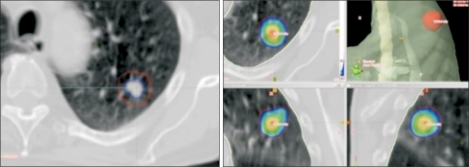
Fig. 2This patient had initially undergone resection of a T2N0 primary non-small cell lung cancer and single fraction stereotactic radiosurgery for 2 synchronous brain metastases. Eleven mo later, after radiosurgery to 2 more brain metastases, they developed a solitary metastasis in the right adrenal gland measuring 5.3 cm in diameter (left, arrow), which was treated with stereotactic ablative lung radiotherapy to a dose of 60 Gy in 8 fractions. The 60 Gy dose (colored area, middle panel) tightly covers the treatment volume. A computed tomography scan 4 mo later shows a reduction in diameter to 3.3 cm (right, arrow).
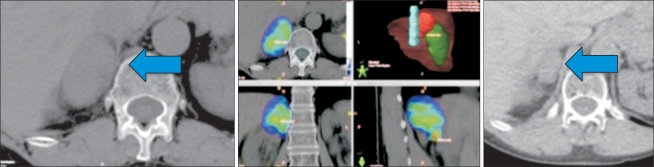
Fig. 3This patient had previously undergone a single fraction of palliative radiotherapy for a painful vertebral metastasis, and subsequently developed progressive local pain. A magnetic resonance imaging scan (left) revealed progressive vertebral destruction and thecal sac/spinal cord compression. Whilst respecting the tolerance of the spinal cord, stereotactic re-irradiation delivering a minimum dose of 8 Gy per fraction to most of the tumor volume (colorwash) was possible. The patient received 2 fractions, and the maximum point dose in the tumor was 13 Gy per fraction.
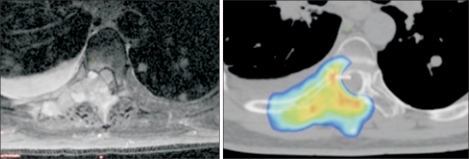
Table 1Reasons why a randomized clinical trial of conventional radiotherapy vs. SABR for medically inoperable peripheral stage I NSCLC may be unlikely to succeed
Table 2Examples of potential patient groups and clinical scenarios for whom routine clinical treatment or studies with SABR may be appropriate
Figure & Data
REFERENCES
Citations
Citations to this article as recorded by 
- Synchronous Double Primary Malignancy of Non-Small Cell Lung Cancer and Glioblastoma: A Case Report and Literature Review
Joseph Carmicheal, Kurtis C. Johnson, Beth K. Neilsen, Nicole Shonka, Chi Zhang, Michael Baine
Case Reports in Oncology.2025; 18(1): 330. CrossRef - Navigating patient journey in early diagnosis of lung cancer in India
Bivas Biswas, Deepak Talwar, Priti Meshram, Pramod K. Julka, Anurag Mehta, SP Somashekhar, Srinivas Chilukuri, Abhishek Bansal
Lung India.2023; 40(1): 48. CrossRef - Design, Synthesis and Anticancer Evaluation of Nitroimidazole Radiosensitisers
Lydia P. Liew, Avik Shome, Way W. Wong, Cho R. Hong, Kevin O. Hicks, Stephen M. F. Jamieson, Michael P. Hay
Molecules.2023; 28(11): 4457. CrossRef - Breast Metastasis of Lung Cancer After Computed Tomography-Guided Core Needle Biopsy: A Case Report
Rong Zhao, Jun Xing, Jinnan Gao
Frontiers in Surgery.2022;[Epub] CrossRef - Radiosurgery and fractionated stereotactic radiotherapy in oligometastatic/oligoprogressive non-small cell lung cancer patients: Results of a multi-institutional series of 198 patients treated with “curative” intent
Michela Buglione, Barbara Alicja Jereczek-Fossa, Marco Lorenzo Bonù, Davide Franceschini, Andrei Fodor, Isa Bossi Zanetti, Marianna Alessandra Gerardi, Paolo Borghetti, Davide Tomasini, Nadia Gisella Di Muzio, Olga Oneta, Marta Scorsetti, Ciro Franzese, P
Lung Cancer.2020; 141: 1. CrossRef - Staging Lung Cancer
Girish S. Shroff, Chitra Viswanathan, Brett W. Carter, Marcelo F. Benveniste, Mylene T. Truong, Bradley S. Sabloff
Radiologic Clinics of North America.2018; 56(3): 411. CrossRef - Stereotactic Body Radiation Therapy for Early-Stage Non–Small Cell Lung Cancer: A Primer for Radiologists
Jennifer A. Febbo, Ramya S. Gaddikeri, Palmi N. Shah
RadioGraphics.2018; 38(5): 1312. CrossRef - Preliminary comparison of the registration effect of 4D-CBCT and 3D-CBCT in image-guided radiotherapy of Stage IA non–small-cell lung cancer
Zhibo Tan, Chuanyao Liu, Ying Zhou, Weixi Shen
Journal of Radiation Research.2017; 58(6): 854. CrossRef - Narcissus, the Beam, and lung cancer
Gaetano Rocco
The Journal of Thoracic and Cardiovascular Surgery.2016; 152(2): 338. CrossRef - Efficacy of stereotactic radiotherapy for brain metastases using dynamic jaws technology in the helical tomotherapy system
Taro Murai, Akihiro Hayashi, Yoshihiko Manabe, Chikao Sugie, Taiki Takaoka, Takeshi Yanagi, Tetsuya Oguri, Masayuki Matsuo, Yoshimasa Mori, Yuta Shibamoto
The British Journal of Radiology.2016; 89(1066): 20160374. CrossRef - Targeting tumour hypoxia to prevent cancer metastasis. From biology, biosensing and technology to drug development: the METOXIA consortium
Erik O. Pettersen, Peter Ebbesen, Roben G. Gieling, Kaye J. Williams, Ludwig Dubois, Philippe Lambin, Carol Ward, James Meehan, Ian H. Kunkler, Simon P. Langdon, Anne H. Ree, Kjersti Flatmark, Heidi Lyng, Maria J. Calzada, Luis del Peso, Manuel O. Landazu
Journal of Enzyme Inhibition and Medicinal Chemistry.2015; 30(5): 689. CrossRef - Monte Carlo validation of the TrueBeam 10XFFF phase–space files for applications in lung SABR
Tony Teke, Cheryl Duzenli, Alanah Bergman, Francis Viel, Parmveer Atwal, Ermias Gete
Medical Physics.2015; 42(12): 6863. CrossRef - Stratégies d’évaluation de la réponse après irradiation stéréotaxique des cancers bronchiques primitifs et des métastases pulmonaires
I. Barillot, O. Munier, M. Hatime, F. Mornex
Cancer/Radiothérapie.2014; 18(4): 308. CrossRef - Short-Course Treatment With Gefitinib Enhances Curative Potential of Radiation Therapy in a Mouse Model of Human Non-Small Cell Lung Cancer
Sivan M. Bokobza, Yanyan Jiang, Anika M. Weber, Aoife M. Devery, Anderson J. Ryan
International Journal of Radiation Oncology*Biology*Physics.2014; 88(4): 947. CrossRef - Can an alternative backround-corrected [18F] fluorodeoxyglucose (FDG) standard uptake value (SUV) be used for monitoring tumor local control following lung cancer stereotactic body radiosurgery?
Charles Shang, Michael Kasper, Vindu Kathriarachchi, Rashmi Benda, Joseph Kleinman, Jeremy Cole, Timothy Williams
International Journal of Cancer Therapy and Oncology.2014; 2(3): 020317. CrossRef - Stereotactic ablative body radiotherapy combined with immunotherapy: Present status and future perspectives
N.H. Rekers, E.G.C. Troost, C.M.L. Zegers, W.T.V. Germeraad, L.J. Dubois, P. Lambin
Cancer/Radiothérapie.2014; 18(5-6): 391. CrossRef - Cáncer de pulmón
P. Resano Barrio, Y. Anta Mejía
Medicine - Programa de Formación Médica Continuada Acreditado.2014; 11(67): 3983. CrossRef - Increasing Use of Advanced Radiation Therapy Technologies in the Last 30 Days of Life Among Patients Dying As a Result of Cancer in the United States
B. Ashleigh Guadagnolo, Kai-Ping Liao, Sharon H. Giordano, Linda S. Elting, Thomas A. Buchholz, Ya-Chen Tina Shih
Journal of Oncology Practice.2014; 10(4): e269. CrossRef - Extra-thoracic tumor burden but not thoracic tumor burden on 18F-FDG PET/CT is an independent prognostic biomarker for extensive-disease small cell lung cancer
Jong-Ryool Oh, Ji-Hyoung Seo, Chae Moon Hong, Shin Young Jeong, Sang-Woo Lee, Jaetae Lee, Jung-Joon Min, Ho-Chun Song, Hee-Seung Bom, Young-Chul Kim, Byeong-Cheol Ahn
Lung Cancer.2013; 81(2): 218. CrossRef - Changing trends in radiation therapy technologies in the last year of life for patients diagnosed with metastatic cancer in the United States
B. Ashleigh Guadagnolo, Jinhai Huo, Kai‐Ping Liao, Thomas A. Buchholz, Prajnan Das
Cancer.2013; 119(5): 1089. CrossRef - Escaping death to quiescence: Avoiding mitotic catastrophe after DNA damage
Zhiyuan Shen, Steven C. Huhn, Bruce G. Haffty
Cell Cycle.2013; 12(11): 1664. CrossRef - CyberKnife robotic image-guided stereotactic radiotherapy for oligometastic cancer
B.A. Jereczek-Fossa, I. Bossi-Zanetti, R. Mauro, G. Beltramo, L. Fariselli, L.C. Bianchi, C. Fodor, P. Fossati, G. Baroni, R. Orecchia
Strahlentherapie und Onkologie.2013; 189(6): 448. CrossRef - The development of stereotactic body radiotherapy (SBRT) for medically inoperable early stage non-small cell lung cancer: an international phenomenon
Gregory M. M. Videtic
Journal of Radiation Oncology.2012; 1(1): 3. CrossRef - Improving lung cancer survival; time to move on
Marlies E Heuvers, Joost P Hegmans, Bruno H Stricker, Joachim G Aerts
BMC Pulmonary Medicine.2012;[Epub] CrossRef - Radiographic changes after lung stereotactic ablative radiotherapy (SABR) – Can we distinguish recurrence from fibrosis? A systematic review of the literature
Kitty Huang, Max Dahele, Suresh Senan, Matthias Guckenberger, George B. Rodrigues, Aaron Ward, R. Gabriel Boldt, David A. Palma
Radiotherapy and Oncology.2012; 102(3): 335. CrossRef
 PubReader
 ePub Link
 Cite
 XML Download
The Role of Stereotactic Ablative Radiotherapy for Early-Stage and Oligometastatic Non-small Cell Lung Cancer: Evidence for Changing Paradigms


Fig. 1
This peripheral stage I lung tumor (left) was treated using 3 fractions of 18 Gy. The panel on the right side shows the colorwash representing high-dose regions within the planning target volume (red contour).
Fig. 2
This patient had initially undergone resection of a T2N0 primary non-small cell lung cancer and single fraction stereotactic radiosurgery for 2 synchronous brain metastases. Eleven mo later, after radiosurgery to 2 more brain metastases, they developed a solitary metastasis in the right adrenal gland measuring 5.3 cm in diameter (left, arrow), which was treated with stereotactic ablative lung radiotherapy to a dose of 60 Gy in 8 fractions. The 60 Gy dose (colored area, middle panel) tightly covers the treatment volume. A computed tomography scan 4 mo later shows a reduction in diameter to 3.3 cm (right, arrow).
Fig. 3
This patient had previously undergone a single fraction of palliative radiotherapy for a painful vertebral metastasis, and subsequently developed progressive local pain. A magnetic resonance imaging scan (left) revealed progressive vertebral destruction and thecal sac/spinal cord compression. Whilst respecting the tolerance of the spinal cord, stereotactic re-irradiation delivering a minimum dose of 8 Gy per fraction to most of the tumor volume (colorwash) was possible. The patient received 2 fractions, and the maximum point dose in the tumor was 13 Gy per fraction.
Fig. 1
Fig. 2
Fig. 3
The Role of Stereotactic Ablative Radiotherapy for Early-Stage and Oligometastatic Non-small Cell Lung Cancer: Evidence for Changing Paradigms
| Benchmark | Comment |
|---|---|
| Is there equipoise amongst treating and referring physicians? | It is difficult to argue that there is equipoise or uncertainty given the local control data in favour of SABR. This now includes institutional, phase II, meta-analysis and population-based sources [5,6,11,13]. In a number of countries, SABR is now regarded as a standard of care for patients with medically inoperable peripheral early-stage NSCLC. |
| Is one treatment as convenient as the other? | This is not the case as SABR is typically delivered in 3-8 intermittent fractions and finished within 1-2.5 wk [6], whereas conventionally fractionated RT may require upwards of 20-30 daily fractions and take 4-6 wk or more to complete. More hypo-fractionated conventional treatments require up to 15 daily fractions that can be delivered in 3 wk [18]. The available data suggests that patient convenience and the efficacy and favourable toxicity associated with SABR may be key factors that influence treatment uptake in elderly patients with co-morbidity [11]. Furthermore recent advances in RT technology have enabled treatment times for each session of SABR to be shortened considerably in recent times [4]. |
| Do the two interventions represent equally effective use of constrained resources? | This is unlikely to be the case as modern conventionally delivered RT still requires image-guidance and it uses more treatment slots and a longer total time on the treatment machine (see above). Combined with an a priori lack of equipoise, this means that conventional treatment might actually use more resources for a less favourable outcome. Comparisons between the resources required for an established conventional lung RT service with those deployed early on in a lung SABR program (e.g., for treatment planning and quality assurance workflows) may be inappropriate, as substantial improvements in overall efficiency can be expected with SABR once experience increases and provided that the program is designed effectively. |
| Are there lessons from other clinical scenarios? | There are analogies to be drawn with localized prostate cancer, where no high-quality, RCT exists to support one active intervention over another [19]. There are other examples where a lack of randomized data to support one intervention over another, including for example surgery versus radiosurgery for brain metastases [20] has not hindered their widespread clinical use. |
| Are RCT the only way to assess lung SABR and the associated technological advances? | While some maintain that a RCT is the only way in which to truly evaluate an intervention, they can have many potential limitations including cost, concerns over general applicability of findings, insufficient power, the time taken to generate results and the risk that these will be redundant when they are reported [21]. A RCT may also not be the best way in which to assess technological advances [22], and it may be impractical or inappropriate when there is sufficient alternative evidence to support a treatment, for example lung SABR for medically inoperable early stage NSCLC, which is already standard of care in some countries. |
| Cancer type and stage | Patient group/Clinical scenario | Routine clinical use or suitable for a clinical study |
|---|---|---|
| Early-stage NSCLC | Medically operable patients or medically operable patients who decline surgery |
Routine clinical use |
| Medically operable patients | Clinical study | |
| Re-irradiation after full-dose conventional RT | Clinical study | |
| Stage IV NSCLC | Patients with 1-5 oligometastases, either following systemic chemotherapy or in those who decline or are unable to receive chemotherapy |
Clinical study |
| If no study then routine use in selected patients. | ||
| A prospective institutional, multi-center or national registry may be useful. |
||
| Patients with NSCLC and EGFR mutation | As above | |
| Concurrent SABR and systemic treatment (e.g., targeted therapy) |
Clinical study | |
| Maximal tumor debulking using SABR±other ablative interventions as part of a multi-modal management strategy |
Clinical study | |
| If no study then use may be justifiable in selected patients |
Table 1
Reasons why a randomized clinical trial of conventional radiotherapy vs. SABR for medically inoperable peripheral stage I NSCLC may be unlikely to succeed
SABR, stereotactic ablative radiotherapy; NSCLC, non-small cell lung cancer; RT, radiotherapy; RCT, randomized controlled trial.
Table 2
Examples of potential patient groups and clinical scenarios for whom routine clinical treatment or studies with SABR may be appropriate
SABR, stereotactic ablative radiotherapy; NSCLC, non-small cell lung cancer; RT, radiotherapy; EGFR, epidermal growth factor receptor.


